

FrogBox Sports Camera recognised in the 2026 Australian Good Design Awards
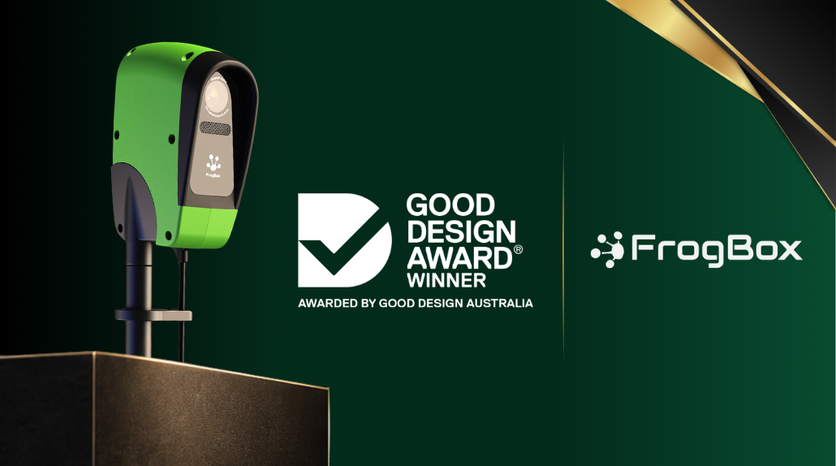
We’re proud to share that the FrogBox Sports Camera has been recognised as a 2026 Australian Good Design Award Winner in the Product Design – Sport and Lifestyle category.
It is a significant recognition for a product that has been several years in the making and, more importantly, one that was designed around a challenge we have been working on since FrogBox first started streaming community sport: how do you take something technically complicated and make it simple enough that a club volunteer can reliably use it every weekend?
The camera itself is only one part of that challenge. Streaming a sporting match involves cameras, connectivity, power, encoding, software and plenty happening behind the scenes before a viewer ever sees a picture. At community level, all of that also needs to work at different grounds, in changing weather, across long days and with equipment that is being transported, assembled and packed away between matches every weekend.
As Peter Macaulay, FrogBox co-founder and Chief Innovation Officer, puts it, “Streaming community sport is technically complex, but it shouldn’t feel that way for the people using it. Our job has always been to take that complexity away and make the experience at the game simple and reliable. That’s what we set out to achieve with the FrogBox Sports Camera, and we’re incredibly proud to see that recognised.”
Designing for community sport
That thinking was at the heart of the development of our new camera. Most cameras available in the market have understandably been designed for broader applications. They may deliver excellent image quality, but they haven’t necessarily been designed to spend an entire summer day elevated on a tripod beside an oval, operate through changing light and weather, and then be packed into the back of a car and taken somewhere completely different the following weekend.
As FrogBox has grown, we have also moved into more sports and different environments. Indoor venues present their own challenges with artificial lighting, reflections and tighter spaces, while sports such as baseball and volleyball require different framing and camera behaviour again. We wanted to design around those realities and create something purpose-built for community sport. That meant starting with the environment our customers actually operate in and working backwards.
Bringing together the right expertise
We worked closely with specialist partners throughout the development process, including Capgemini on industrial design, electronics engineering, prototyping and reliability testing, Tamron on optics and lens selection, and Entech as our manufacturing partner. Each brought expertise that complemented what we had learned from operating thousands of community sports streams over the years. The process involved plenty of prototypes, testing and changes along the way.
“There wasn’t one breakthrough that suddenly gave us the finished camera,” Peter says. “It was lots of small decisions and improvements. We would test something, learn from it, make a change and go again. That process is ultimately what got us to where we wanted to be.”
Solving for real-world conditions
Some of the most important design decisions were also the least visible. Heat management mattered because electronics sitting in direct sunlight for hours need to continue performing reliably. Power consumption was equally important because clubs regularly stream multiple matches across a full day. Image quality needed to remain consistent as lighting changed, while the physical camera needed to be robust without becoming unnecessarily heavy or difficult to handle.
Those challenges were not solved independently. Each decision affected another part of the product, which meant balancing image performance, thermal management, power, durability, weight and cost across the complete design. It was a process of continuing to test the camera in the kinds of conditions it would actually face, learning from those results and improving it from there.
Designing the whole experience, not just the camera
Importantly, we also knew that improving the camera alone wasn’t enough. A FrogBox customer doesn’t experience a camera in isolation. They experience the tripod they need to carry from the clubhouse, the cables they need to connect, the battery that needs to last through the day and the software they use to get everything running before play starts. So the camera project became an opportunity to revisit the entire FrogBox kit.
The new generation camera introduced a redesigned encoder with greater control over the complete system, a stronger and easier-to-handle tripod, a single-cable connection between the camera and encoder, updated accessories and an in-house camera control experience. We also reduced weight and simplified parts of the setup that had created unnecessary work for clubs with our previous generation.
None of those changes in isolation completely transforms a match day. Together, though, they make the system easier to transport, quicker to set up and more dependable once the game begins. That is ultimately the type of design we value most at FrogBox. There is plenty of sophisticated technology inside a FrogBox kit, but we don't want our customers to have to think about most of it. The better we design the product, the less technical knowledge should be required to operate it.
Receiving an Australian Good Design Award is particularly meaningful because it recognises the thinking and work that has gone into something our customers will mostly experience through simplicity. It was rewarding to see that philosophy reflected so clearly in the Jury’s comments:
“The Jury recognises the FrogBox Sports Camera as a well-engineered solution that brings broadcast-quality live streaming within reach of community sport. The design process successfully eliminated setup complexity, reducing configuration from 25 minutes to just 3 minutes through thoughtful integration of high-quality visual and audio processing. The Jury was impressed by the solid design process, full user experience ecosystem integration, and well-resolved details including appropriate material selection and considered manufacturing. The accessible plug-and-play device addresses real frustrations faced by volunteer-run clubs, with the elevated stand position and automated features particularly commended for enabling reliable outdoor sports capture without requiring technical expertise. Well done.”
A foundation for what comes next
The award also represents an important step in where we are taking FrogBox next. Owning more of the complete capture system gives our product and engineering teams much more ability to improve it over time. We can better connect the camera, encoder and software, remotely understand how equipment is performing and build smarter automation around the way matches are captured.
As Peter says, “The camera isn't the end of the project. It gives us a much stronger foundation to keep developing from. Whether that is smarter automation, remote diagnostics or new hardware options, we can continue improving what happens behind the scenes while ultimately helping more clubs capture their matches, share more moments and create greater value for their communities”
For everyone at FrogBox, and for the partners who have helped us develop the camera, the Australian Good Design Award is a great recognition of the work that has gone into getting here.