

Behind the Box: FrogBox Play Channels have arrived
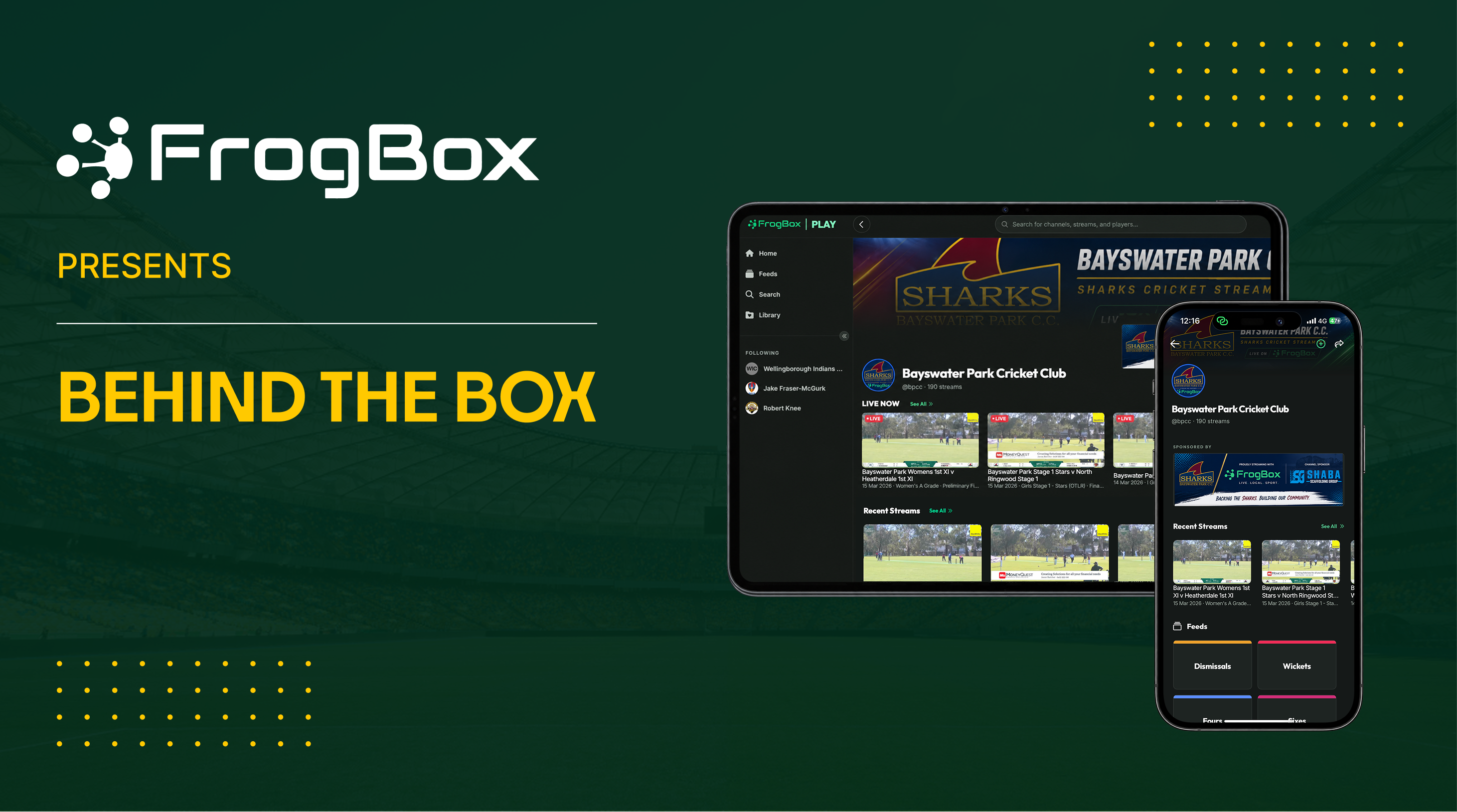
Building a better home for community sports content
FrogBox Play began with a relatively simple purpose: to give players, families and supporters an easier way to discover and watch highlights from community sport.
At the same time, FrogBox customers were already streaming thousands of matches through platforms such as YouTube. That model worked well and helped make community sport accessible to audiences anywhere, but over time we could also see some of its limitations. General video platforms are designed to serve an enormous range of creators and audiences, whereas community sport has a much more specific structure around competitions, clubs, teams, fixtures and participants.
People looking for community sport are usually not browsing for something an algorithm might recommend. They are looking for a particular club, match, team, player or competition they already have a connection with.
As FrogBox Play developed, that distinction started to shape our thinking. Rather than seeing Play primarily as a place for highlights, we began to ask whether it could become the more natural home for all of the video content created through FrogBox.
That has meant bringing live streams and full match replays into the platform alongside highlights, and most recently introducing FrogBox Play Channels. Channels give clubs and competitions their own dedicated video home, where supporters can find upcoming live streams, replays, highlights and sponsor content together in one place.
For us, this is less about replacing one video destination with another and more about designing an experience around the way community sport is actually organised and followed.
“YouTube helped solve a huge distribution challenge for community sport, and it remains an incredible platform,” says FrogBox Chief Executive Officer Rob Knee. “What we have learned, though, is that there is an opportunity to build an experience that better understands the structure of the sport and the community around the video.”
Channels are the latest step in that evolution, but the broader idea is to make FrogBox Play more useful before, during and after the live stream, while giving clubs and competitions a clearer home for the content they are already creating.
Community sport is different
One of the interesting things about community sport is that individual audiences can appear relatively small while the collective audience is enormous. A local club may only have a few hundred people closely connected to it, but across thousands of clubs, teams and competitions there is a significant amount of content being created and a very large number of people who care about it.
That creates a different challenge to a traditional creator platform. The job is not necessarily to help one club build a mass audience, but to make it easier for people to find the sport they are already connected to and to make the content more useful once they get there.
It also shapes how we think about value. Clubs and competitions are creating the matches, developing the players, bringing the audience together and producing an increasing amount of video content in the process. As that ecosystem grows, we think there should be ways for those organisations to participate more directly in the value being created around live streams, replays, highlights and sponsorship.
We do not have every part of that model solved today, but it is an area we are thinking about much more seriously as FrogBox Play develops.
The same broader principle applies to safeguarding. A large proportion of community sport involves children and young people, so consent, identity, visibility and privacy cannot sit outside the product thinking. They need to be part of how the platform is designed from the beginning.
Our Chief Customer Officer, Renee Howes, has been closely involved in that work through her interaction with clubs, governing bodies and families.
“When you work closely with community sporting organisations, you quickly understand that making something technically possible is only part of the job. The technology also has to reflect the environment clubs, volunteers, players and families actually operate in.”
Building specifically for organised sport gives us the opportunity to think about consent, controlled visibility, and safeguarding as part of the platform itself, rather than expecting every club to work out how to manage those issues within a general public video network.
Technology built for how community sport actually operates
Another factor that shapes a lot of our product decisions is the reality that community sport is overwhelmingly run by volunteers. The person setting up a stream may also be playing in the match, coaching a team, marking the ground, organising players or helping in the canteen, and in many clubs the same small group of people are doing several of those things at once.
That means greater capability cannot simply come with greater complexity. It also cannot come at a cost that puts new technology out of reach for the clubs and competitions we are building it for.
We spend a lot of time thinking about new ways to improve the content, from better production and automation through to new forms of highlights, audience experiences and commercial opportunities. The challenge is making sure those ideas are introduced in a way that remains practical and affordable for community sport, or where there is a realistic pathway for clubs to fund them through sponsorship, audience growth or other value created around the content.
A lot of the development happening across FrogBox is therefore focused on making the platform more sophisticated behind the scenes while keeping the experience simple and accessible for the people using it. That means easier capture, more automated production, stronger connections between match data and video, and less manual effort involved in creating and distributing content.
Renee describes that principle simply:
“The best technology in community sport is often the technology people barely notice. If we can remove work for the volunteer while creating a better experience for the supporter, player and club, then we are solving the right problem.”
That thinking has influenced everything from how we approach camera setup to automated highlights, scoring integrations and the way content is organised once a match is finished. It also acts as an important test for new ideas: not simply whether we can build them, but whether they can genuinely work in a community sport environment.
A dedicated home for community sports video
FrogBox Play Channels are the latest step in that broader direction, giving clubs and competitions their own home within FrogBox Play and bringing together live streams, full match replays, highlights and sponsor branding in one place.
On the surface, that may look like a relatively simple product change, but behind it is a broader shift in how we think about the role of FrogBox Play. We increasingly see it as the layer that connects the different parts of community sports video together, from the match being captured and linked to scoring data, through to the live stream, replay, highlights and the club or competition people are already looking for.
That is also why discovery in community sport needs to work differently. If someone follows a club, they should not have to search across unrelated videos to find the next match or the moments that came from the previous one. The structure of the sport itself should help organise the experience.
Channels are not the finished version of what we think FrogBox Play can become, but they are a practical step toward making community sports video easier to find, easier to follow and more useful to the organisations creating it. As the volume of content continues to grow, the opportunity is to connect more of those pieces together across live streams, replays, highlights, participants, clubs, competitions, sponsors and audiences.
Want to learn more?
Explore the FrogBox website, get in touch, or head straight to FrogBox Play at play.frogbox.live and start watching community sport for free.